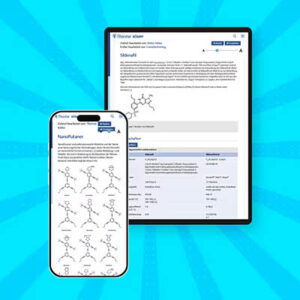
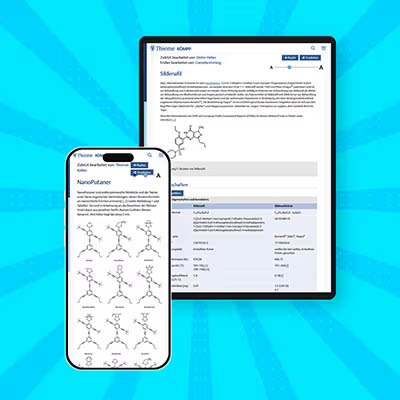
The Contents of RÖMPP SciCapsules
RÖMPP SciCapsules contain over 42,000 highly relevant capsules based on scientific principles. Each individual capsule is written by a subject expert and is structured and categorized by subject area:
Biotechnology and Genetic Engineering
The field of biotechnology and genetic engineering offers information from the fields of bioreaction engineering, molecular genetics, and immunology.
Chemistry
The field of chemistry accounts for the largest number of capsules within RÖMPP. All subdisciplines of chemistry are covered and RÖMPP is a leading source of validated knowledge in this area.
Environmental and Process Technology
Environmental and process technology are increasingly gaining focus. Capsules related to the circular economy and sustainability are also described in this field.
Food Chemistry
In addition to the chemistry of various foodstuffs, the field also deals with analytical methods relating to food.
Materials Science and Materials Engineering
The materials science and materials engineering section contains useful information on construction materials, functional materials, and many other topics.
Natural Products
The field of natural products provides quick access to information, for example, about phytochemicals and metabolites from bacteria, bryophytes, and fungi.


The Advantages of RÖMPP SciCapsules
RÖMPP SciCapsules offer you well-founded answers to your questions:
- NCitable source for your next term papers, assignments, and posters
- NEasy to digest units useful in exam preparation or lecture and lesson planning
- NReliable, evidence-based content created by subject experts
- NCareful review ensures accurate and well-founded information
- NRichly interlinked to enable fast and complete knowledge acquisition
- NPermanent links, essential for LMS (learning management systems) used in schools, universities, and corporates
- NInteractive: create content playlists, collections, and reading lists for yourself or for sharing with students or colleagues add notes and highlighting
- NBroad range of coverage with over: 42,000+ capsules with hundreds of thousands of cross-references, 26,000 structural formulas and graphics, 60,000 web links, 180,000 further referencesnd highlighting
- NTranslated from the German original with the help of cutting-edge AI
RÖMPP SciCapsules Licenses
The advantages of RÖMPP SciCapsules for your institution.
An institutional license to RÖMPP SciCapsules comes with the following advantages:
- NAvailable to institutions through the Internet
- NSeveral licensing options allow for flexible agreements
- NUnlimited campus- or site-wide access controlled through your institution’s IP address
Thieme offers RÖMPP SciCapsules for schools and universities, institutions, authorities and companies. Just contact us for your individual quotation!
The Editors of RÖMPP, Specialists in Their Fields
Get to know our editors.
Biotechnology and Genetic Engineering
 Prof. Dr. Georg Sprenger
University of Stuttgart, Germany (retired)
Topics: genetics, genomics, cell biology, immunology, microbiology, systems biology, bioinformatics, agrobiotechnology, ethics, safety, organizations
 Prof. Dr. Sandy Schmidt
University of Groningen, Netherlands
Topics: technical methods, medicine, biopharmaceuticals, bioelectrochemistry, agrofood, environment, analytics, ethics, safety, organizations
Chemistry
 Dr. Bernd Dill
Topics: theoretical, physical, inorganic, and applied chemistry, physics, occupational safety, laboratory technology, coatings, printing inks, chemo- and bioinformatics
 Prof. Dr. Frank Böckler
Eberhard Karls University of Tübingen, Germany
Topics: pharmacy, medicine, toxicology
 Prof. Dr. Philipp Heretsch
Leibniz University Hannover, Germany
Topics: organic chemistry, biochemistry, macromolecular chemistry, plant protection, nomenclature
Food Chemistry
 Prof. Dr. Gerhard Eisenbrand
Technical University of Kaiserslautern, Germany (retired)
Topics: food law, nutrition, animal and plant foods, additives, food technology, food analysis and safety, food contact materials, cosmetics, food microbiology, tobacco products
 Prof. Dr. Reinhard Matissek
Technical University of Berlin, Germany (retired)
Topics: food law, nutrition, animal and plant foods, additives, food technology, food analysis and safety, food contact materials, cosmetics, food microbiology, tobacco products
Natural Substances
 Dr. Burkhard Fugmann
Bayer AG, Engineering & Technology (retired)
Topics: carbohydrates, metabolites from bacteria, fungi, arthropods, and mammals plant constituents, structurally unusual natural products, fats, oxylipins
 Prof. Dr. Georg Pohnert
Friedrich Schiller University Jena
Topics: alkaloids, amino acids, nonribosomal peptides, polyketides, terpenes, metabolites from marine organisms and bryophytes
Materials Science and Materials Engineering
 Prof. Dr. Franz Faupel
Christian Albrechts University of Kiel, Germany
Topics: metals, polymers, composites, MOFs, ceramics, porous materials, magnetic and optical materials, biomaterials, nanomaterials, computational materials science, corrosion, recycling, surfaces, semiconductors, energy, testing methods
Environmental and Process Technology
 Prof. Dr. Thomas Gamse
Graz University of Technology, Austria
Topics: environment, ecology and ecotoxicology, process engineering, law, organizations
 Dr. Andreas Rühling
Röhm GmbH, Innovation Management Methacrylates, Germany
Topics: sustainable chemistry, computer simulation, renewable resources, catalysis
The Reliable Online Source for Chemistry and Related Natural Sciences
RÖMPP SciCapsules offer you well-founded answers to your questions:
- NCitable source for your next term papers, assignments, and posters
- NEasy to digest units useful in exam preparation or lecture and lesson planning
- NReliable, evidence-based content created by subject experts